
In January 2020, not long after CBS (owner of 50% of the Doctor Who TV licence) merged with Viacom (the owner’s of Paramount Pictures, who themselves owned the Doctor Who Movie licence), the new company, ViacomCBS commissioned a report into the future of the Doctor Who franchise, amidst it’s new ownership, alongside the BBC. The report, which was completed and published internally within ViacomCBS and BBC Studios, although the BBC had nothing to do with the report itself, in May 2020, could only suggest the relevant changes needing to take place, and BBC Studios had no legal obligation to enact any, however, the report made for intresting reading and did form the basis for many announcements about the Doctor Who franchise made in the coming months afterwards.
The report analysed several elements of the franchise: Brand, Audience and Leadership – all of which were elements the report found to be crucial to the continued success of the franchise. It also went onto detail how the franchise needed to move forward in the era of COVID-19, which when commissioned in January, was not much of a concern to ViacomCBS, but by May, certainly was. Although the report made passing mention to the Foreign Adaptations, they were not the subject of review and where not explored in any detail within the report.
Section I – Brand
The report felt that the brand of Doctor Who had been vastly deteriorated since 2013, which it put mainly down to the back-and-forth rivalry between CBS and Paramount, calling it ‘unhealthy‘ for the brand. It condemned the decision taken by Executive Producer, Adrian Hodges, to relaunch Season 53 as the beginning of Chapter 5, and especially condemned the change of logo, arguing it, wasn’t a very strong identifiable logo for the brand, lacking much of the character of the franchise, and that a sudden change in logo in such a short space of time confused audiences.
The report suggested doing much the same Paramount achieved with the Star Trek brand in 2009 and unifying it’s logo, no matter what incarnation it be, whether film or television, which show, which chapter, etc… To create a strong brand, the report said that there was a strong need for cohesion. The report said that despite the fact the Chapter Five logo was very weak, it would be a mistake for another new logo to be designed to replace it so soon, as this would confuse audiences even more and weaken the brand. However, it did suggest resurrecting an old logo, audiences would recognise and already identify with Doctor Who as the unified brand logo. It put forward four suggestions: original 1963 logo, 1974 logo, 2003 logo… and finally, the one it suggested most of all, the 1970 logo, as it suggested this had the most character of the Doctor Who brand, and was the most versatile, looking good in both a stacked and single-line variation, whereas the 1963 one was asymmetrical and the 1974 logo had the issue of the diamond having to fit onto the branding. The report suggested that really only the 1970 or 2003 logo becoming the unified brand logo would be a good idea, and put favour on the 1970 logo. It said that in doing would be the only alternative to the current Chapter Five logo – a vastly week brand.
Additionally, the report found that the Chapter classification, which had been in use since the late-2000s was (according to their focus groups) confusing and alienating to audiences, arguing for a simplification of the Chapter allocation, perhaps evening them out, as well as unifying each Chapter under one-singular brand for the franchise. After much conference, the report suggested reclassifying the Chapters like so: Chapter One: Seasons 1-17, Chapter Two: Seasons 18-34, Chapter Three: Seasons 35-52, and in keeping with Season 53 being marketed as Series 1, Chapter Four: Seasons 53-onwards. The report did also suggest that while in the long-term a new chapter-classification along these lines would be very positive for the brand, in the short-term it could damage the brand and confuse audiences even more. The report therefore suggested using a different name which wasn’t ‘Chapter’, or alternatively giving each chapter it’s own subtitle such as ‘Doctor Who: The Beginning’ or something of the sort.
Finally, the report suggested that to strengthen the brand, all spinoffs, current, future and past should be renamed to include the name Doctor Who and the Doctor Who brand logo in them. It suggested that spinoffs would be repackaged as Doctor Who: Leftover, Doctor Who: Panopticon and Doctor Who: The Elysium for example. It specified that this would only be on cover art, and streaming services’ listings in order to best market the brand and the actual episodes would not be tampered with in any way. It also suggested that ViacomCBS should attempt to buy-out the rights to the international distribution to The Elysium from Netflix, as it deemed the company holding the rights to it could be extremely problematic going forward.
The report went to suggest that on streaming services, and perhaps on DVD releases, each episode of Doctor Who’s backcatalog, main show or spinoff, as well as all future episodes, be edited to open with a 5-second Doctor Who franchise sting, featuring the brand unified logo, a by-line with ‘A BBC Studios and ViacomCBS Presentation’, as well as a leitmotif of the Doctor Who theme tune. It said doing so would heavily increase brand cohesiveness across the board.
The report did, however, praise the way Espenson had been reorganising the Doctor Who Franchise to have each aspect of it’s output focus on a different Doctor. It said this has helped, and will likely continue to, strength the brand and viewership overall. It said that audiences will be more likely to watch a Doctor Who show, if a Doctor headlines it, than just a random group of people on a random planet, like other spinoffs, before it. It essentially said, well done, keep on doing this.
Finally, the report outlined that the franchise should steer away from marketing itself as dark and broody and should accentuate the optimistic and positive elements of Doctor Who throughout it’s marketing. It cited that the promotion of The New Renegade has been problematic and confusing, and also used the calamity which was Season 51 to demonstrate it’s point.
Changes instigated by ViacomCBS and BBC Studios
Following the report, the following changes in relation to the Brand were instigated by the Doctor Who licence holders.

- May – A week after the report was published, the 1970 logo was reintroduced as the official Doctor Who logo, for all parts of the franchise, old and new. Two variations were found in the official brand guidelines, a stacked version and a single-line version (which was only to be used when the stacked one didn’t work in it’s context). The title sequence for Vajahnari’s Curse revealed this change to the public, as the Season 53 logo was replaced with the new brand logo.
- July – ViacomCBS and BBC Studios decided to not retroactively alter the names of previous Doctor Who spinoffs, however they did instigate that any Doctor Who show releasing new content must use the Doctor Who prefix, in all cases. So, according to these rules, if the Elysium had been given a sixth season, the show would’ve been forced to be renamed Doctor Who: The Elysium for that season.
- October – The new Chapter classification was officially announced to the public, in the same form as stated in the report. After much debate, it was decided to keep the name Chapter, but with an entirely new look and feel, brand wise, it was made clear to the public that the new Chapter classification was in-fact new.
ViacomCBS and BBC Studios did attempt to buy the distribution rights to The Elysium from Netflix, but they refused, citing that they had exclusive rights in territory outside the USA and the UK to distribute the show, up until five years after the final episodes’ release. After several rounds of talks, ViacomCBS decided to give up on the idea of buying the rights, instead choosing to wait four years. This did spark rumours that given the situation, The Elysium could make a return in 2024 – ViacomCBS denied this.
Section II – Audience
The report heavily focused on the dwindling nature of Doctor Who’s viewership over the previous five-years and once-again attributed lot’s of this due to the rivalry between CBS and Paramount Pictures, suggesting that the unfocused and confrontational output put many viewers off the show, even to the point where it was actively hindering the creative vision of the show’s writers and producing, citing Ronald D. Moore’s firing.
It went onto say that the Doctor Who franchise seemed to be going through something of an identity crisis and needed to pick an identity – fast. While Doctor Who: Adventures‘ audience seemed pretty much a given, the report made the point that it’s method of distribution completely muddled it’s audience. Doctor Who: Adventures, an animated cartoon aimed towards 4-8 year-olds was only available as a CBS All Access exclusive, and although CBS All Access was to be rebranded in 2021 as Paramount+, it still meant that a cartoon for children was behind a paywall their parents would have to pay for, which they’d only pay for if the service also enticed the parents, to be deemed worth it. The report concluded that having Doctor Who: Adventures being a Paramount+ exclusive was a big error, as only Doctor Who fans seemed to be the ones watching it, and it really wasn’t aimed at them. The report suggested it would better suit the audience if ViacomCBS distributed the show through another one of their subsidiary companies, Nickelodeon. The report suggested that in the summer, during the school holidays, the first season is repeated in full on Nickelodeon, but marketed as essentially a new show (with the titles altered to include the new logo), and then the episodes can be put into the Nickelodeon rerun cycle until Season 2 premieres. As for the UK, it suggested that CBBC are given exclusive first-run rights to any new season of the show, but after a certain time-frame, Nickelodeon UK could enter the episodes into it’s rerun cycle too.
The report then went onto look at Paramount+‘s other original Doctor Who series, Doctor Who: The New Renegade. The report said that The New Renegade needed to find its target audience, as it was a nostalgia-baiting, TV-MA rated show, with gratuitous violence and language, but with an alienating plot about finding God. The report said that The New Renegade either needed to be a dark adult sci-fi show dealing with difficult social issues, which is very suited to it’s streaming only status in the US, or it needed to be a nostalgia filled, fan pleasing, piece of family entertainment, full of fun adventures in the TARDIS… the report said it couldn’t be a weird mix of the both, as Season 1 had been, as this likely alienated and confused the audience.
It also made the point that franchising a Doctor Who adaptation to Indian channel Doordarshan on the eve of the ViacomCBS merger, when Viacom operated their own rival channel in India, was a bit of a silly move but as a six season exclusivity contract had been signed with Doordarshan, the report concluded that nothing could be done about this.
Additionally, the report looked into the new scheduling, which began with Season 53. It looked at the viewing figures and audience engagement, and while it did see some benefits, it concluded that the experiment had failed and audiences would rather have the series all-in-one-go. It suggested either moving back to a week-by-week schedule or, as had become the fashion lately, releasing the entire series as one boxset on the night of Episode 1’s premiere.
Finally, the report looked towards the main show, Doctor Who, saying that it needed to be for everyone. As the main torchbearer of the franchise, it had to appeal to 4 year olds through to 90 year olds, not stuck inside it’s own canon, brooding to itself about the tragedy of the week. Above all, the report suggested that Doctor Who needed to drastically rework itself to be fun and energetic, citing the distinct lack of humour within Season 53 and the first serial of Season 54, suggesting that Doctor Who should partly be written as a laugh-a-minute comedy series, to keep audiences constantly entertained. It went onto cite many instances throughout the Doctor Who franchise where this approach worked. The report strongly condemned any marketing of Doctor Who as dark and edgy and if it said anything else, it heavily suggested that Doctor Who needed to be reworked to be witty, funny and full of adventure. It summarised that the last time a Doctor Who season even approached this was Season 49, and it’s some of that tone the show needs to try and recapture.
Changes instigated by ViacomCBS and BBC Studios
Following the report, the following changes in relation to the Audience were instigated by the Doctor Who licence holders.
- August – ViacomCBS reran the first season of Doctor Who: Adventures on Nickelodeon, to great success, strongly increasing the popularity of Doctor Who with children in the USA. They later announced that Season 2 would be premiered on Nickelodeon too. CBBC and Nickelodeon UK failed to come to an agreement about the channel airing Doctor Who: Adventures in the UK, and CBBC held onto the show, in full.
- December – It was announced that the next season of Doctor Who would not be airing on the same schedule as the previous two seasons and instead it would air for a continued run when it returned in Autumn 2021.
Section III – Leadership
The report was merciless when it came to scrutinising the leadership the Doctor Who franchise was under. It said that while having a Franchise Executive was very positive for the franchise and the brand, it claimed that the choice of Franchise Executives since the departure of Ira Steven Behr were mistaken. The report criticised Ronald D. Moore’s appointment as Franchise Executive in 2015, suggesting that this heavily deterred his ability to lead the main show, splitting his focus throughout several other projects. It instead gave the opinion that Ronald D. Moore should’ve been deposed from the role of Franchise Executive but kept as the Executive Producer and Showrunner of Doctor Who. However, it also mercilessly criticised the subsequent appointment of Jane Espenson, as she was, and always had been, part of the Ronald D. Moore team and appointing her, in the report’s opinion, contradicted the whole reason Moore was sacked in the first place. It went onto say that Jane Espenson seemed to be overstretched during the production of Season 52, running both Doctor Who and The Elysium as well as dealing with running the rest of the Franchise. It said that Espenson’s previous closeness to Moore and his regime, being a leading figure in it, made the job several times more difficult. It then went onto suggest that the Franchise Executive role be given to someone with the credentials of an accomplished executive within the industry, who knew the franchise well, and not necessarily a writer for the show.
It went onto detail that the role of the Franchise Executive was about cohesion. Its job is to overlook each area of the Doctor Who Franchise: Television, Film, Merchandise and Distribution and ensure that they all work together cohesively. It suggested that perhaps this role wasn’t fit for purpose within a franchise as large and as important to ViacomCBS and the BBC as Doctor Who. The report outlined that each of the four areas of the Franchise should have their own Executive Supervisor, with the Franchise Executive managing each one of these supervisors. The hierarchy, as follows, is what the report suggested the franchise move towards.
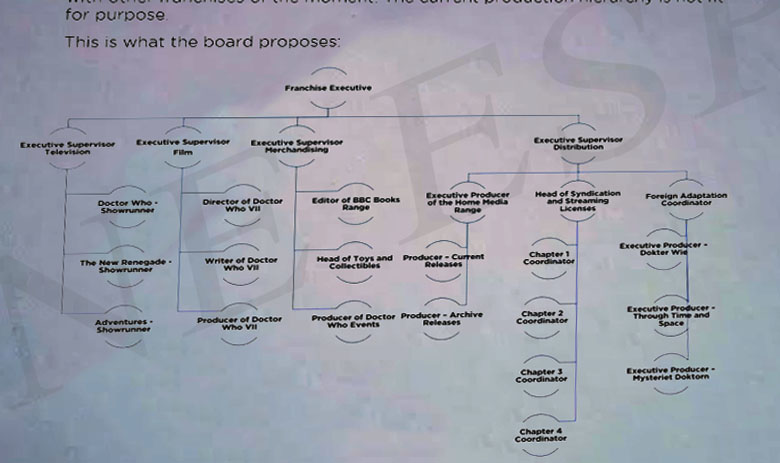
It suggested that Jane Espenson become the Executive Supervisor of Television, only, and the other roles, including that of Franchise Executive appointed to other people. It also moved the Foreign Adaptations into the hands of the Distribution arm of the franchise, as they were simply licensed shows made by different television studios across the world, and shouldn’t have much to do with the Main Television side of things. The report also made the point that no-single person should hold more than just one of these roles, as that’s where many of the problems originated in the previous few years.
The report also pointed out that with the Doctor Who franchise owned by ViacomCBS and BBC Studios, it meant that Doctor Who products could be now distributed on BBC One, BBC Two, BBC Four, BBC iPlayer, All UKTV channels including Drama, W, Alibi & Yesterday as well as Paramount+, CBS, Nickelodeon, PlutoTV, Network 10 (in Australia) and also Channel 5 (in the UK), as Viacom recently purchased the channel. The report said that the Executive Supervisor of Distribution‘s main job was to organise synergy between all these platforms and to make sure each aspect of the Doctor Who franchise found it’s ideal place to be.
The report made the point that the Doctor Who franchise needs to give a clear identity to each of it’s products, which still feel cohesive and part of the same franchise, but work on capturing different target audiences in order to widen the franchises’ reach.
Changes instigated by ViacomCBS and BBC Studios
Following the report, the following changes in relation to the Leadership were instigated by the Doctor Who licence holders.
- July – The Doctor Who Production Office was reorganised as stated above, however Jane Espenson was not happy with the changes, especially as she was essentially demoted from Franchise Executive to Executive Supervisor – Television, as the report suggested a different type of leader in the role of Franchise Executive. Soon after, BBC executive, Mal Young was announced as the new Franchise Executive, succeeding Espenson and her new boss. Adrian Hodges remained as the showrunner of Doctor Who, itself.
- August – After the a few weeks of interviews for the roles, Young appointed Jeffrey Chernov as Executive Supervisor – Film, Nicki Shead as Executive Supervisor – Merchandising and Maggy Chan as Executive Supervisor – Distribution.
- September – Maggy Chan announced that Channel 5 would be airing all 5 seasons of The Elysium over the next few months, Alibi would be repeating Leftover, Drama would be repeating the newly classified Chapter 2 and W would be repeating the newly classified Chapter 3, while Yesterday were given the rights for repeating Chapter 1. Network 10 would be given exclusive rights to air Doctor Who in Australia. Chan also made the decision, for cost reasons, and because she personally didn’t feel it was necessary, to suspend the bilingual approach to Doctor Who: Through Time and Space and instead give the show a traditional dub, as well as air it on BBC Four – this decision was extremely controversial.
Section IV – COVID-19
The report concluded with a section, added not long before the publication of the report, about how the Doctor Who franchise should deal with the COVID-19 crisis. It spent a lot of this time laying out details for a safe social-distanced production but it also detailed it’s suggestions for the further broadcast of the franchise, in light of the crisis.
When the report was published, only the first two episodes of Season 54 had aired. The BBC had already released two different plans in which either 6 or 8 episodes of Season 54 would air across the remainder of the year. The report said it believed the 8 episode plan was achievable, as long as filming resumed by September 1st at the latest. It said if Scotland’s lockdown measures by that point were too stringent, then it should be considered moving production to England, for the final 2 episodes of the season. The report said that a decision has to be made about which scenario is undertaken by July 5th, at the latest. After this, no matter how the pandemic changes, this has to be stuck to.
The New Renegade Season 2 was originally supposed to begin production in June 2020, with a January 2021 air-date, but obviously this wasn’t possible. The report suggested prioritising the production of The New Renegade Season 2, and aiming for a June 2021 air date. Contrastingly, it suggested that Doctor Who should not begin production to at least January 2021, and instead air for a September 2021 air date, for a continuous run, so the show and the production team could have a lengthy break to rejuvenate the quality presented on screen. It suggested scrapping the rest of what should have been Season 54, and instead rebuilding Season 55 from scratch, but running for a manageable 8×50 episodes, matching what did air of Season 54. It also suggested scrapping the serial format, instigated by Adrian Hodges in 2019.
Next it spoke about Doctor Who VII, which was originally set to begin filming in January 2020, but was pushed back to October 2020 due to pre-production delays. The report suggested that the film begin production as planned in October 2020, but instead of being released in cinemas in December 2021, it suggested the film should be given a smaller more TV-like budget, and be released as a Paramount+ original film in the Spring of 2021, if possible, to help the launch of the streaming service.
Finally, the report strongly suggested using the time given to the production team by COVID-19 to work on building up the Doctor Who brand, and getting it into a stronger and more positive place by September 2021. It referenced lots of the points it made earlier in the report to ensure this could happen.
Changes instigated by ViacomCBS and BBC Studios
Following the report, the following changes in relation to the COVID-19 were instigated by the Doctor Who licence holders.
- November – Production on The New Renegade Season 2 began, with a shorter run of 8 episodes, with an intended release date of June 2021.
- October – Production on Doctor Who VII began, as a smaller-scale TV-style movie, intended for a Paramount+ release in May 2021. BBC One announced they would premiere the TV movie.
- January – Production on Season 55 of Doctor Who began, with 8×50 minute episodes, airing in September 2021.
So with that grilling report published and a whole host of changes enacted, dramatically shifting the balance of power within the Doctor Who Franchise and regenerating the brand going into 2021… what exactly will happen next and what will the upcoming seasons look like?
 WIDWWA
One thought on “ViacomCBS’ Report into the Future of the Doctor Who Franchise”